
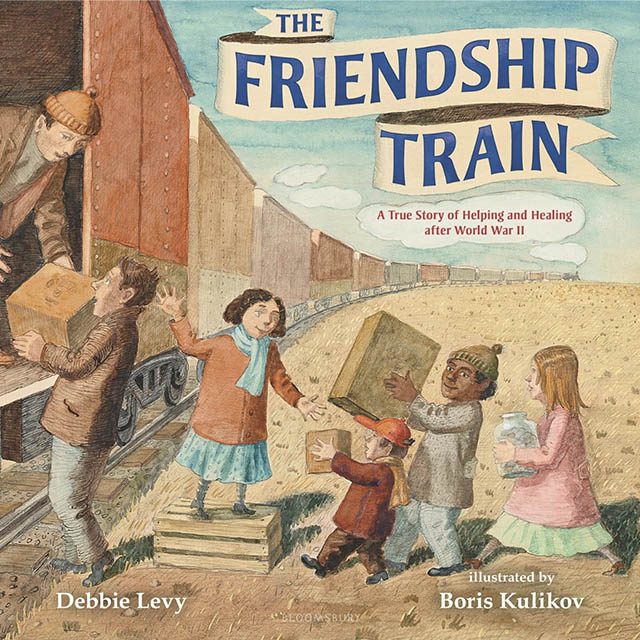
The Friendship Train: A True Story of Helping and Healing after World War II
By Debbie Levy
Illustrated by Boris Kulikov
Bloomsbury Children’s Books, 2025.
Ages 5-8
This new book is an inspiring story of national and international cooperation, showcasing the very best of humanity.
On one side of the ocean, children’s bellies growled. A war had ended. Fighting had destroyed farms. Winter was coming to Europe, and there was no time to grow food before the cold set in. There was peace, but not enough to eat.”
Journalist Drew Pearson in Washington DC wanted to help and looked for others to join the cause. He wrote articles and the readers responded. For example, on Halloween, kids asked for “treats of nuts and dry fruits and flour and macaroni for the hungry people across the sea.”
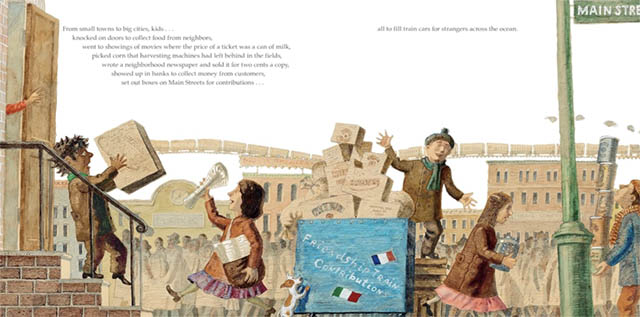
The Friendship Train, which ran from the West Coast to the East collecting good food for those hungry bellies. Americans, especially children, gave what they could. Folks donated their allowances, sold newspapers, collected food from neighbors, then they loaded packages onto trucks and boxcars and ships to cross the sea.
Twelve Boxcars left California and by the time the train reached Chicago 100 Boxcars rolled east. Eleven days after the friendship train left Los Angeles 200 Boxcars reached New York Harbor. In the end 500 boxcars were collected. On December 7, 1947, FOUR giant steam ships left America bound for Europe.
Thank you, Drew Pearson.
Still recovering from the war, the recipients didn’t have a lot to give, but they found a way, their own train full of ways, to express their gratitude. In 1949, a ship returned to America full of forty-nine Boxcars loaded with thousands of gifts. Every state received a “thank you boxcar.”
I was pleased to see that the author’s note provides additional information about the “Friendship Train”, including detail into Levy’s primary source research.
Submitted by Karen Kosko
