
Policing the Crisis
By Antonia Darder
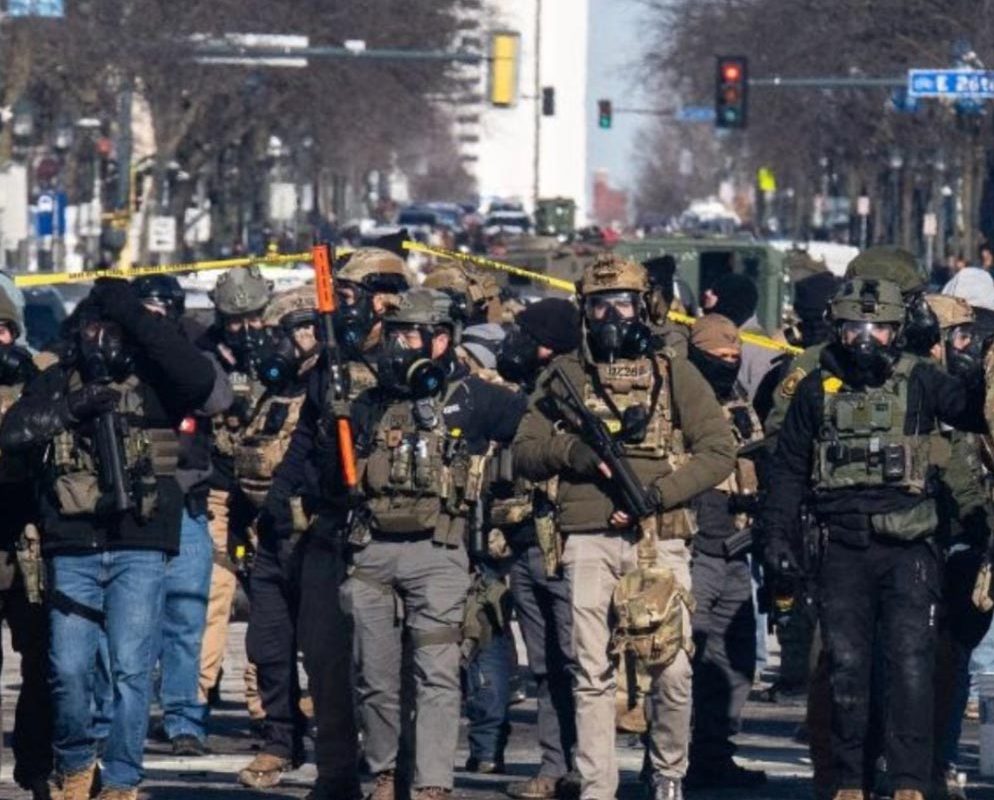
“The rage felt seeing this photo of Federal agents in Minneapolis inspired this poem. My way of contending with the anger and grief.”
They call it a crisis.
As if a mother’s quivering hand
was a hurricane.
As if a child’s small shoe on desert sand
was a national emergency.
As if hunger was an invading army.
They say border security
and mean armored trucks
in poor brown neighborhoods.
They say rule of law
and mean rifles slung across chests
in front of daycare centers at dawn.
Helicopters beat the sky
like a ruthless heart,
metallic and merciless
circling apartment complexes
where curtains barely move
because fear has weight
and presses down on fabric,
on lungs, on dreams, on prayers.
We have watched them
drag fathers away in handcuffs
as if they were traffickers of poison,
not men who wash dishes until midnight,
who patch drywall for little pay,
who build houses they will never own.
We have watched them
question tiny children
as if crayons were contraband,
as if lullabies were coded messages,
as if a backpack were a bomb.
We have seen the cages.
We have seen the foil blankets
that shine like cheap halos
around bodies shivering
under fluorescent lights.
We have seen toddlers
cry for mothers who
are three walls away
hearing their babies weep.
What name do we give this?
They call it enforcement.
We call it terror.
They call it protection.
We call it invasion.
In the streets, agents move
as if deployed in foreign lands,
faces hidden behind sunglasses,
Black masked vigilantes with
hands resting on holsters
like punctuation marks at the
end of every sentence:
Stop.
Papers.
Proof.
Prove you belong.
Belonging,
as if this land were not soaked
with migrations older than fences;
as if the soil did not remember
Indigenous footsteps
long before it memorized
property lines.
We are told this is necessary.
Necessary to save democracy.
Necessary to restore order.
But what is democracy
when children are taught
that uniforms mean disappearance?
What is order
when neighbors vanish between
one sunrise and the next?
What is safety
when fear becomes
the air we breathe?
We watch, and sometimes
all we can do is watch,
as courthouses become hunting grounds,
as schools become checkpoints,
as hospitals whisper to themselves
about who is safe to treat.
We scroll through headlines
like obituaries for a republic:
rights suspended,
due process eroded,
accountability deferred.
Bit by bit,
the architecture of freedom
is dismantled with bureaucratic precision.
A policy here.
A raid there.
An executive order signed
with a pen that does not tremble.
And we ask,
What can we do?
What shall we do?
How do we stand upright
when law becomes lawlessness?
When impunity wears a badge
and calls itself virtue?
How do we keep tyranny
from shattering our spirits,
from fracturing our souls
into quiet compliance?
We chose to remember.
We remember that every empire
has called its cruelty necessary.
We remember that every cage
was once defended as temporary.
We remember that the arc of justice
is not a myth,
but it does not bend
without hands upon it.
Our hands.
We gather in living rooms
and church basements
and union halls.
We form circles of translation,
know-your-rights workshops,
rapid response networks
that move faster than fear.
We become witnesses
who refuse to look away.
We become neighbors
who open doors.
We become teachers
who speak the unspeakable.
We learn the names
they want erased.
We say them in classrooms,
in courtrooms,
in city council chambers.
We refuse the lie
that some children
are disposable.
We refuse the myth
that humanity has
a visa requirement.
And when they march in formation,
we answer in solidarity.
When they raise walls,
we build bridges of stubborn love.
When they attempt to isolate us,
we link arms until isolation collapses.
This is how we keep our spirits:
by giving them to one another.
This is how we guard our souls:
by refusing to surrender compassion
to the machinery of fear.
The crisis is not migration.
The crisis is militarized cruelty.
The crisis is a democracy
that forgets its own promises.
But we are still here.
In every chant that echoes off concrete,
in every legal brief filed at midnight,
in every hand that grips another
as sirens wail in the distance,
we are still here.
And as long as we are here,
the story is not finished.
Let them call it a crisis.
We will call it a reckoning.
Let them brandish power.
We will practice courage.
Let them police the crisis.
We will organize the dawn.
