
Why Parents Need Support Long Before Recruiters Arrive
May 25, 2026 / Gary Ghirardi / National Network Opposing the Militarization of Youth (NNOMY)
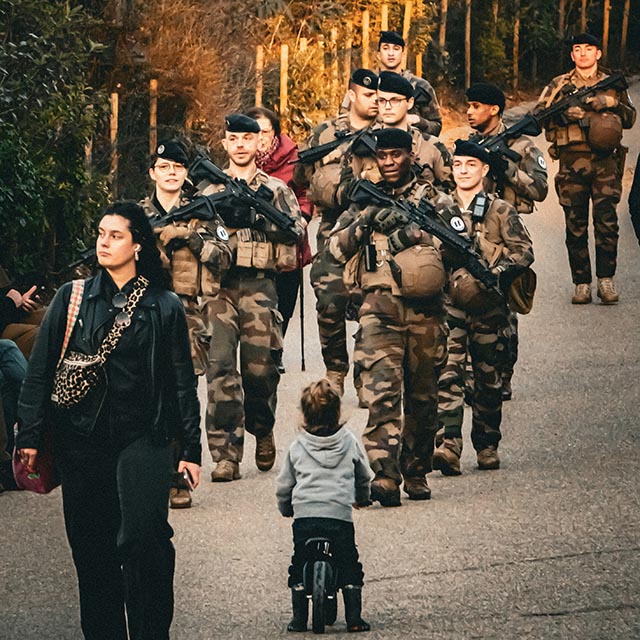
In early‑childhood education, we often talk about the environments that shape a child’s sense of safety, belonging, and possibility. We know that children learn not only from what adults teach them, but from the stories, symbols, and expectations that surround them. Yet one of the most powerful influences on children’s understanding of conflict and community often goes unspoken: the quiet, steady presence of militarism in their schools and neighborhoods. For many families, the first signs appear long before adolescence — sometimes as early as kindergarten — through school assemblies, visiting uniformed personnel, or classroom activities sponsored by military programs that present themselves as simple enrichment. In elementary schools, children encounter military presence through patriotic assemblies, classroom visits framed as community service, and STEM programs such as STARBASE that are presented as educational opportunities rather than military initiatives. By the time a child reaches middle school, these influences have already begun shaping their sense of identity and their understanding of what it means to “serve.”
For the National Network Opposing the Militarization of Youth (NNOMY), this early exposure is not an abstraction but a daily reality. Parents frequently tell us that they did not realize how deeply military messaging had entered their children’s school lives until a moment of surprise or discomfort made it suddenly visible. A seven‑year‑old comes home excited about “soldier science day.” A middle‑schooler joins a leadership club that turns out to be run by JROTC cadets. A high‑school student is automatically scheduled to take the ASVAB without parental consent. These moments reveal a pattern that is national in scope and deeply personal in impact.
Parents are not failing to notice; they are navigating a system that rarely explains itself. Schools seldom disclose the origins of military‑sponsored programs, and many educators themselves are unaware of the broader strategy behind them. The Pentagon’s youth‑outreach initiatives are designed to appear neutral, educational, and community‑oriented. This lack of transparency leaves families without the information
They need to make thoughtful decisions about their children’s learning environments. It also creates a sense of social pressure. In many communities, questioning military presence in schools feels taboo, even when the concern is simply about age‑appropriateness or informed consent. Parents may hesitate to speak up, fearing they will be misunderstood or judged.
Meanwhile, children absorb these messages long before they can analyze them. A uniformed visitor in a classroom becomes a symbol of authority and admiration. Posters and reading materials that celebrate military identity become part of the imaginative world children use to understand safety, bravery, and belonging. Without guidance, children may internalize the idea that conflict is resolved through force, that authority should not be questioned, or that military service is the primary way to contribute to one’s community. Peace education seeks to nurture empathy, cooperation, and critical thinking, but these values cannot take root if parents are unaware of the competing narratives shaping their children’s understanding of the world.
This is why peace education must include parent education. Families need support long before a recruiter ever walks onto a high‑school campus. They need help recognizing the subtle ways militarism enters early‑childhood spaces, and they need language to talk with their children about peace in ways that are developmentally appropriate. Parents often tell us they want to raise children who can think critically, act compassionately, and resolve conflicts nonviolently, but they feel unprepared to counter the cultural messages that surround them. They want to advocate for their children, but they are unsure how to approach school administrators or how to ask questions without feeling confrontational. They want to offer their children meaningful alternatives—pathways rooted in community, creativity, and service—but they do not always know where to find them.
NNOMY’s work is grounded in the belief that parents deserve clarity, support, and community. We have seen how powerful it can be when families understand the systems shaping their children’s lives and feel confident engaging with schools about them. We have also seen how difficult this work can be. Militarism is normalized in American culture, and many schools rely on military programs to fill gaps in funding or staffing. Parents are overwhelmed by the demands of daily life and may not have the time or energy to investigate the origins of school programs. And peace education itself is often undervalued in school systems that prioritize academic metrics over emotional literacy, cooperation, and nonviolence.
Yet the need is urgent. Children are forming their earliest understandings of conflict, fairness, and belonging long before adolescence. They are learning how to interpret authority, how to respond to fear, and how to imagine their futures. If we want them to grow into adults who can build peaceful communities, we must begin by supporting the adults who guide them. Peace educators, early‑childhood teachers, and parent networks are natural partners in this effort. Together, we can help families develop the confidence to ask questions, the tools to nurture empathy at home, and the clarity to recognize when militarized messaging is shaping their children’s experiences.
NNOMY’s work is not about opposing individuals in uniform. It is about helping families understand the systems that influence their children and offering peaceful, community‑strengthening alternatives that honor children’s dignity and potential. When parents feel supported, they can create home environments where curiosity, compassion, and critical thinking flourish. When educators and caregivers work together, they can build school cultures that value cooperation over competition and dialogue over discipline. And when communities commit to transparency and shared responsibility, they create the conditions in which peace education can truly thrive.
A militarized society teaches children to prepare for war. A peaceful society teaches adults to prepare children for peace. The work begins early, long before high school, and it begins with all of us—parents, educators, caregivers, and communities—choosing to raise children who can imagine a world shaped not by fear, but by care.
Gary Ghirardi — Communications Staff Person — NNOMY office
Additional readings for
- Parents — https://www.nnomy.org/community-action/parents
- Teachers — https://www.nnomy.org/community-action/Community-Action
- Students — https://www.nnomy.org/community-action/students
- Community Action — https://www.nnomy.org/community-action
